University of Bayreuth, Press Release No. 092/2026, 17 November 2026
Chromium atoms stabilize a ruthenium catalyst for water electrolysis
Bayreuth researchers use X-rays to track how a chromium-modified ruthenium catalyst changes during operation
As part of his doctoral research, Tengyu Chen of the Institut de Ciències Fotòniques (ICFO) succeeded in synthesizing an active and highly robust ruthenium-chromium catalyst. The ICFO-led team demonstrated in laboratory tests that the catalyst remains more stable during water electrolysis under acidic conditions than the commercial catalysts tested. The results suggest that neighbouring chromium atoms act as a protective shield, limiting the undesirable oxidation of ruthenium. Researchers at the University of Bayreuth helped elucidate the underlying mechanism using X-ray absorption spectroscopy (XAS). The study has been published in the journal Nature Materials.
In water electrolysis, water is split into hydrogen and oxygen using electrical energy. Oxygen evolution at the anode is particularly challenging. Ruthenium-based catalysts are highly active for oxygen evolution in acidic environments. At high potentials, however, ruthenium can oxidize and be leached out of the catalyst in the form of soluble compounds. As a result, the electrolyzer’s performance declines over time.

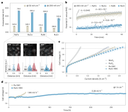
Comparison of ruthenium catalysts with iron, cobalt, nickel, and chromium, and their performance in a PEM water electrolyzer. The ruthenium-chromium catalyst was tested at a current density of 1 A/cm² for 285 hours. During this time, the required cell voltage increased by an average of 0.28 mV per hour.
The Author(s) 2026, Chen et al., Nature Materials, Abb. 5.
Why it matters
Green hydrogen—that is, hydrogen produced using electricity from renewable sources—is considered a key building block for a climate-neutral energy supply. It can be produced using electricity from wind and solar power plants and then used in industry, chemical production, heavy-duty transportation, or for energy storage. A key challenge is maintaining the performance of electrolyzers over long periods of time. The new study shows how catalysts can be stabilized at the atomic level. Longer-lasting catalysts could reduce maintenance requirements and lower the costs of green hydrogen production.
Chromium as a Protective Shield for Ruthenium
In the catalyst under investigation, ruthenium and chromium atoms are closely linked via oxygen bridges. Measurements and calculations suggest that the electrical charge within this arrangement redistributes in response to the applied potential. Some of these changes are reversible. This may explain why ruthenium oxidizes less readily in the new catalyst and is therefore leached from the material more slowly or in smaller quantities.
Experiments in Bayreuth Provide Evidence
Researchers from the University of Bayreuth conducted the relevant XAS measurements at the BESSY II synchrotron at the Helmholtz-Zentrum Berlin, where the ruthenium K-edge was measured at the BAMline and the chromium K-edge at the KMC-3 beamline. Dr. Bruna Ferreira Gomes Lobo, a research associate in the Electrochemical Process Engineering group, led the XAS investigations on the Bayreuth side and evaluated the spectra together with Linlin Yang (ICFO). The X-ray spectra showed that ruthenium in the new catalyst underwent less oxidation during oxygen evolution than the reference material. “Our measurements suggest that neighbouring chromium atoms mitigate the oxidation of ruthenium during oxygen evolution. This helps explain why ruthenium dissolves more slowly in the new catalyst,” explains Dr. Bruna Ferreira Gomes Lobo. The XAS data, together with the results from microscopy and calculations, support the explanation that chromium reduces the oxidation of neighbouring ruthenium atoms during operation.
In half-cell tests, the ruthenium dissolution rate determined to 0.03 micrograms per square centimeter per hour. This is less than one-fiftieth of the dissolution rate of the commercial catalyst without chromium additives. In a proton exchange membrane (PEM) electrolyzer, the new catalyst was tested for 285 hours at 1 A/cm². During this time, the cell voltage increased by an average of 0.28 mV per hour. For the comparison catalysts, the voltage increase was nearly 7 times higher (catalyst without chromium) and nearly 15 times higher (commercial catalyst), respectively.
The “protective shield” or “redox buffer” principle could help develop more stable catalysts for other electrochemical applications as well. For practical application, however, further investigations using larger electrodes and over longer operating periods are necessary.
The research was conducted in close collaboration with several international institutions. The ICFO – Institut de Ciències Fotòniques in Barcelona led the project. The Federal Ministry of Education and Research (BMBF) funded the work through the Live-XAS (05K22WC1) and HighHy (03SF0689B) projects. In the follow-up project, Real-XAS, the Bayreuth research group continues to collaborate with the Helmholtz Center Berlin at the KMC-3 beamline.
Original publication: Tengyu Chen et al.: Proximal redox coupling enables oxidation damping for stable water electrolysis. Nature Materials.
DOI: https://doi.org/10.1038/s41563-026-02783-4

Dr. Bruna Ferreira Gomes LoboElectrochemical Process Engineering
Faculty of Engineering Science
University of Bayreuth
Phone: +49 921 55 7203
E-mail: bruna.lobo@uni-bayreuth.de
Faculty of Engineering Science
University of Bayreuth

Dr. Stefan Fehm-DanoglidisPress Spokesperson, University of Bayreuth
Telephone: 0921 / 55-5300
Mobile: 0175 / 355 3973
email: stefan.fehm-danoglidis@uni-bayreuth.de