University of Bayreuth, Press Release No. 049/2026, 02 July 2026
Mechanism of bacterial signal transduction deciphered
Researchers at the University of Bayreuth and Forschungszentrum Jülich have demonstrated that specific light-sensitive enzymes – so-called sensor histidine kinases (SHKs) – transmit their signal through a light-controlled change in asymmetry. With their new study, the researchers contribute to a better understanding of a central mechanism of bacterial signal processing. This may help to develop new tools for biomedicine or biotechnology. The findings are reported in the renowned journal Science Advances.
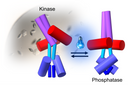
The investigated sensor histidine kinase can switch between a kinase and a phosphatase form in response to blue light. In doing so, it either transfers phosphate groups to other proteins or removes them. The stylized protein structures show spatial arrangement of the protein in the two states. Protein crystals used for the structural analyses are shown in the background. © Ulrich Krauss/Renu Batra-Safferling/ChatGPT Image 2
Why it matters
SHKs are key bacterial signalling proteins that play an important role in many processes: from controlling which genes are active at a given time to enabling the ability to cause disease. Artificially engineered light-sensitive SHKs are also used in optogenetics to precisely control gene activity with light. However, only limited structural information has been available so far for the full protein. The new study provides important insights into how natural and engineered SHKs transmit signals across multiple protein domains. In the long term, the study may help to develop new optogenetic tools that allow biological processes to be precisely controlled using light. This is particularly relevant for applications in biotechnology and biomedicine.
SHKs are part of two-component systems in bacterial signalling pathways. They consist of a sensor that detects environmental stimuli such as light, and a regulator that controls the response to a stimulus such as altered gene expression. Depending on the system, SHKs can trigger different responses in light or darkness: they either transfer phosphate groups to a regulator or remove them. This regulator then controls further molecular processes within the cell, such as changes in gene activity. Although SHKs are responsible for a wide variety of signalling pathways in bacteria and are also used in optogenetics – a biological technology that controls cellular activity with light – the precise mechanisms of signal transmission remain largely unclear. This problem was addressed by a research team from the University of Bayreuth and Forschungszentrum Jülich.
“In our study, we examined newly engineered light-sensitive SHKs, which can be used as optogenetic tools, both structurally and functionally. We combined crystallographic data with analyses of the proteins in solution and functional tests,” says Professor Dr. Ulrich Krauss from the Biochemistry I research group at the University of Bayreuth, who is also a visiting scientist at the Institute of Molecular Enzyme Technology of Heinrich-Heine-University Düsseldorf, which is part of Forschungszentrum Jülich’s Institute of Bio- and Geosciences IBG-1. This combination of methods enabled the researchers to accurately assign the active dark state and the light-induced structural change of the SHKs. “Close collaboration between different institutes and research groups at Forschungszentrum Jülich and the University of Bayreuth was crucial for deciphering the mechanism of signal transduction,” adds Professor Dr. Renu Batra-Safferling, head of the Protein Biochemistry research group at Forschungszentrum Jülich.
In the SHKs studied, an asymmetrically bent form occurs in the dark, whereas light favours a symmetrical, straight structure. “The transition between these two forms is closely linked to the kinase activity of the enzyme, i.e. the transfer of phosphate groups to the regulator,” explains Batra-Safferling. Functional and structural investigations of the enzyme in solution suggest that the asymmetrically bent form possesses kinase activity, whereas the symmetrical, straight form exhibits phosphatase activity, i.e. it removes phosphate groups from the regulator. Thus, the spatial structure of the SHK largely determines whether phosphate groups are transferred or removed – a central step in the regulation of gene activity by two-component systems. “Put simply, in the asymmetrical form, key parts of the enzyme are oriented in such a way that kinase activity is possible. The transition to the symmetrical, straight form changes this arrangement and renders the components incompatible with the kinase function. This favours phosphatase activity over kinase activity,” Krauss adds.
The researchers are currently investigating how universal this mechanism is for other SHKs and what role protein dynamics generally play in signal transduction in light-sensitive proteins in a further project.
The study was conducted as part of a project funded by the German Federal Ministry of Education and Research (BMBF) (OptoSys; funding codes 031A16 and 031A167B) and was also supported by the German Research Foundation (DFG).
Source: Vladimir Arinkin, Andreas M. Stadler, Stefanie S.M. Meier, Karl-Erich Jaeger, Andreas Möglich, Ulrich Krauss, Renu Batra-Safferling. Dimer asymmetry in signaling of blue-light sensor histidine kinases. Science Advances (2026)
Prof. Dr Ulrich KraussBiochemistry I
University of Bayreuth
University of Bayreuth
Phone: +49 (0)921 / 55-7830
E-mail: Ulrich.Krauss@uni-bayreuth.de

Theresa HübnerDeputy Press & PR Manager
University of Bayreuth
University of Bayreuth
Phone: +49 (0)921 / 55-5357
E-mail: pressestelle@uni-bayreuth.de