Logo Universität Bayreuth

University of Bayreuth, Press Release No. 022/2026, 24 March 2026

The University of Bayreuth presents its research on mosquitoes on the MS Wissenschaft

In 2026, the University of Bayreuth will be part of the major floating science exhibition on the MS Wissenschaft, which sets sail from Berlin on 7 May and will subsequently visit around 35 cities in Germany, Austria and, for the first time, Poland. Under the theme ‘Medicine of the Future’, the exhibition ship will demonstrate how research today is helping to rethink healthcare. The University of Bayreuth will be represented with its own exhibition – focusing on a topic that exemplifies the challenges of a globalised world: mosquitoes as disease vectors in the context of climate change, biodiversity and planetary health.

Das Schiff MS Wissenschaft ist auf einem Fluss zu sehen

The Bayreuth exhibit is entitled ‘Mosquitoes are becoming a threat – yet they fulfil valuable ecological roles’. It demonstrates how closely the environment, animals and humans are interconnected – and how these interdependencies affect our health. The exhibition explores key ideas from One Health and Planetary Health: both concepts emphasise that human health is inextricably linked to intact ecosystems, stable climatic conditions and sustainable economic practices.

Due to climate change, travel and global trade, invasive species such as the Asian tiger mosquito (Aedes albopictus) are increasingly spreading across Europe. It can transmit pathogens such as the Chikungunya, Dengue or Zika viruses. At the same time, native species such as the common house mosquito (Culex pipiens) can transmit novel pathogens such as the West Nile virus.

Global changes, local impacts

“Mosquitoes provide an ideal way to illustrate the links between biodiversity, climate and health,” says Dr Stephanie Thomas, a researcher at the Chair of Biogeography, coordinator of the elite Master’s programme in Global Change Ecology, and a lecturer on the international Master’s programme in Environment, Climate Change and Health, which is supervised by Professor Wilm Quentin. “They highlight how global changes have local impacts – and why we must always consider health in the context of the interplay between humans, animals and the environment.”

The Bayreuth exhibition combines wall graphics, fact sheets, 3D models and short video clips. Visitors will learn, among other things:

  • how invasive mosquito species spread,
  •  which diseases different species can transmit,
  •  how climate change is shifting the ranges of mosquitoes and diseases,
  •  how researchers model these distribution patterns and assess risks,
  •  why mosquitoes fulfil important ecological functions despite the risks they pose.
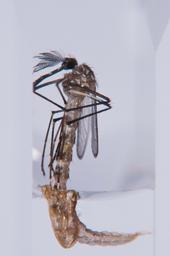
Eine Stechmücke in Nahaufnahme

The photo shows an Asian tiger mosquito just emerging from its pupa.

A key feature is two mosquito profiles, which introduce typical species:

The Asian tiger mosquito (Aedes albopictus)

Distribution: worldwide; present in Europe since the 1990s
Habitat: small pools of water in urban areas, such as rainwater barrels or plant saucers

Viral diseases: Chikungunya, dengue, Zika and others

The common house mosquito (Culex pipiens)

Distribution: almost worldwide, particularly in Europe and North America
Habitat: nutrient-rich water bodies, cellars, drains
Viral diseases: West Nile, Sindbis, Rift Valley and Usutu viruses

Research from Bayreuth

The exhibition is based on work carried out by two research units at the University of Bayreuth: the Chair of Biogeography investigates changes in biodiversity, invasive mosquito species and the diseases they carry. Meanwhile, the Chair of Planetary & Public Health explores the links between the environment, climate and health, and how healthcare systems can become more resilient. Stephanie Thomas has been working in vector ecology for over ten years and is involved in international projects on biodiversity, climate change and health.

A project with a wide reach

Preparations for participation in the joint exhibition on the MS Wissenschaft have been underway since November 2025. The exhibition will be set up at the end of April. The project is financially supported by outreach funds from the University of Bayreuth and additional funding from the University of Bayreuth Association and the Bayreuth Centre for Ecology and Environmental Research. Paul Birkner, a student on the Global Change Ecology Master’s programme, will act as a scientific guide on board the exhibition. Stephanie Thomas will be present at selected stops.

Jugendliche stehen um einen Ausstellungstisch und betrachten die Exponate

The MS Wissenschaft is a project run by Wissenschaft im Dialog (WiD) on behalf of the Federal Ministry of Research, Technology and Space. The exhibition features around 30 interactive exhibits that visitors aged 12 and over can try out for themselves – from AI-assisted diagnostics to virtual operating theatres. Opening hours: daily 10am–6.30pm (for school groups from 9am) Guided tours: daily at 5pm, additionally at 11am at weekends.

From 1–3 September, the MS Wissenschaft will be in Aschaffenburg; from 8–11 September, it will be in Würzburg. 

The full tour schedule is available here: https://ms-wissenschaft.de/de/besuch/tour/

Further information about the project can be found on the website 
https://ms-wissenschaft.de

Dr. Stephanie Thomas

Dr. Stephanie Thomas

Postdoc Biogeography research group

Phone: +49 (0)921 / 55-2306
E-mail: stephanie.thomas@uni-bayreuth.de

Gert-Dieter Meier

Gert-Dieter MeierScience Communication

Phone: +49 (0)921 / 55-5356
E-mail: gert-dieter.meier@uni-bayreuth.de

Zentrale Universitätsverwaltung (ZUV), Office 3.09
Universitätsstraße 30, 95447 Bayreuth