Mathematics is regarded as a key discipline for numerous modern professional fields. At the same time, international comparative studies such as PISA show that students’ mathematical competences have declined significantly in recent years – both in Germany and internationally. Moreover, students differ, for example, in terms of learning pace, interests and competences. Against this background, the question of how mathematical potential can be fostered as effectively as possible in the classroom is gaining increasing importance.
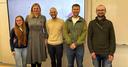
The “MaDiMat” project was initiated by Dr. Moritz Zehnder of the University of Bayreuth and addresses precisely this issue. Its focus is on the initial and further training of student teachers and practising teachers in the Bavarian–Czech border region. The project is implemented by the Chair of Mathematics and Mathematics Education at the University of Bayreuth in cooperation with the University of West Bohemia in Pilsen. “MaDiMat” is co-financed by the European Union under the INTERREG Bavaria–Czech Republic 2021–2027 programme and runs from January 2026 to December 2028. The total funding amounts to more than 488,000 euros, with just over 313,000 euros allocated to the University of Bayreuth.
The cooperation between the universities of Bayreuth and Pilsen brings together diverse subject-specific didactic perspectives and areas of expertise. The planned activities address both university-based teacher education and in-service professional development for schools.
Student teachers at the University of Bayreuth acquire competencies in the independent development of differentiated teaching materials through international seminars. These materials are reflected upon and further developed in joint working phases with students from Pilsen. They are then implemented during school placements and scientifically analysed with regard to their impact on teaching and learning processes. In this way, the project deliberately combines theoretical planning with practical application.
In continuing professional development for teachers, “MaDiMat” follows a co-constructive approach: primary and secondary school teachers work together with researchers to develop differentiated teaching materials that can be tested and used directly in the classroom. The cross-border exchange provides additional perspectives and facilitates the transfer of proven good practice.