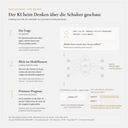
Large Language Models (LLMs) are increasingly being used to analyse attitudes, consumer behaviour and political preferences, as well as to forecast future developments. However, previous studies of preference prediction have focused primarily on the final responses generated by LLMs rather than on the process by which those responses are produced. A research team from Ludwig Maximilian University of Munich and the University of Bayreuth set out to address this issue.
“Previous research approaches that focused solely on analysing AI-generated answers are rather like looking only at the result displayed by a calculator without understanding how the calculation was performed. In our study, we were effectively able to look over the AI’s shoulder as it was thinking,” says Simeon Allmendinger, doctoral researcher in the University of Bayreuth Information Systems and Human-Centred Artificial Intelligence research group.
In the study, the researchers analysed more than 24 million combinations of factors—including the specific language model used, individual demographic characteristics, party constellations and prompts (so-called configurations)—across seven language models and six national elections. Within these different configurations, they investigated which internal regions of the LLMs were activated, how political parties were associated with particular characteristics within the models and how information such as age and educational background was processed.
“We found that the ‘inner workings’ of language models often contain additional information that is not fully reflected in the final answer. Making this information visible using our new method can provide additional insights and improve forecast accuracy,” says Professor Dr. Niklas Kühl, Chair of Information Systems and Human-Centred Artificial Intelligence at the University of Bayreuth.
For example, if a language model is asked to predict which party a person would vote for and its answer is “Party X”, the model may internally contain indications that the person has an equally strong association with Party Y.
“Our results show that the models learn more about underlying relationships than they ultimately reveal in their final output,” Kühl explains. “It is important to emphasise that this method is intended as a complementary tool and not as a replacement for traditional surveys. Particularly when it comes to underrepresented groups, real-world surveys remain indispensable,” Allmendinger stresses. The study was conducted in collaboration with the Munich Center for Machine Learning (MCML), the Fraunhofer Institute for Applied Information Technology FIT and the University of Maryland.